“The Sign”
In the summer of 2020, I held up my sign proudly. “I DID NOT go to law school just to be KILLED by law.” At the time, I was 24 years old and in my first year of law school. It was the height of the Black Lives Matter movement (“BLM”), and the country was in an uproar following the death of George Floyd.
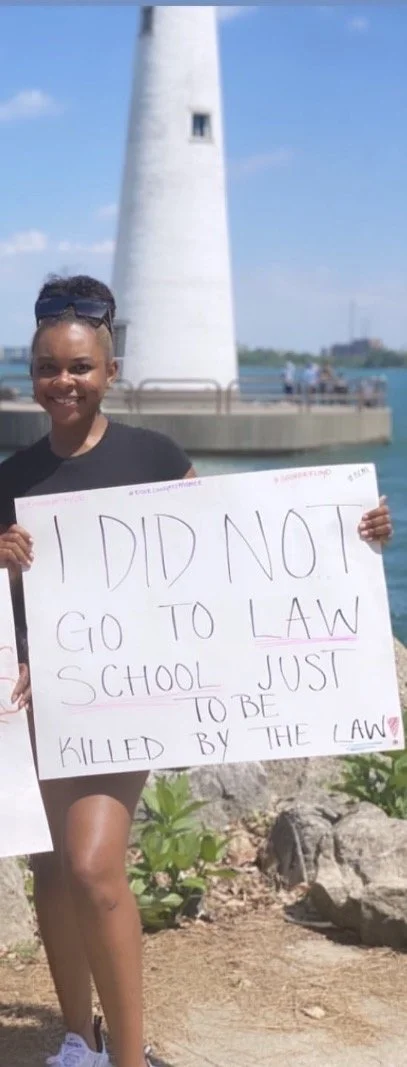
I had never protested in my life. In fact, I had experienced very few racially-charged incidents in my life. I heard a racial slur or two in my life, sure, but growing up in an urban community followed by living in the “suburbs,” I guess I thought that was the status quo. Nonetheless, I grew up in fairly diverse schools and always had friends of every race. My mother used to say that I could “make friends” with anyone. I knew that racism existed, and, as trained in school, I felt a duty to ensure that the terrors of the civil rights movement never happened again.
I had strong opinions growing up and, clearly, a mindset focused on justice, as reflected in my interest in pursuing law. My minor in undergrad at Michigan State University was “Law, Justice, and Public Policy.” Still, I had never made any hard stances or positions, publicly, at least, in my entire life.
My parents had always raised me not to complain about things I wasn’t willing to change. So, when heartbreak was etching through the black community, which I certainly had an opinion about, I thought the only thing for me to do was to make an impact, or at the very least be part of the solution. I hit the pavement with pride.
My family wasn’t political. My parents were born in 1957 and 1961 in Detroit, Michigan, at the height of segregation. My father had an actual memory of the 1967 riots that would alter the city for decades to come. Still, my father worked for over 40 years in the auto industry, as many Detroiters of the time did. We would’ve been considered middle class, I suppose, and we believed in God, family, education, and working hard for the things you desire. Frankly, my family could have and possibly would have been Conservatives (“Republican Party”), based on these fundamentals alone.
The only times I vividly remember politics being discussed at all in my household were when my parents would complain about George Bush and when former President Barack Obama ran for office. I was about 11 years old, and begged my mother—who was very strict about my sleep schedule on school nights—to let me stay up all night to watch the polls. He pulled through, and I sobbed like a baby.
I guess I truly never thought America would see a black President. I was in awe of President Obama and his two daughters, who reminded me so much of myself. Finally, I saw myself represented in the White House. Surely, this would be a turn in the right direction for black America—more on this to come.
At any rate, about 4 years after my participation in the BLM protests, Vice President Kamala Harris was running for President of the United States. Everyone in the black community was ecstatic and supportive, and the media presented her as the breath of fresh air the black community had been waiting for. The evolution of Barack Obama. An African American female president…. The idea should have been, for me— a second-year attorney at this point—the greatest thing to witness. Surely, she should’ve had my full support.
Only, that wasn’t the case….
The alternative, Donald J. Trump, was tainted in the media so badly that he was practically viewed as the new Adolf Hitler. Granted, his previous 4 years in office didn’t leave the best impression on those in my community, so it wasn’t entirely surprising. It should’ve been a no-brainer for me. Still, there was something about Vice President Harris’ campaign that bothered me at my core.
There was something between the half-naked twerking performance at a presidential campaign rally, giving recipes for collard greens when Americans had real concerns, her lack of answering fundamental questions, and her overt panhandling of the black community, that made me uneasy.
Yet, I cast my vote in November 2024 for VP Harris. Eventually, curiosity killed the cat. I grew up as a child consumed with history, social studies, and government. I spent many late nights surfing the web, reading articles that surely put a virus on our family-shared desktop on more than one occasion. I liked to be “properly” informed on any decision I made or any topic I discussed. So I started digging into VP Harris, and most importantly, the Democratic Party, with the same rigor.
Although Formerly Certain is not a partisan-biased platform, because I believe there is only good vs. evil, and each political party is occupied by foreign nations at this point—more on this to come—I do find it necessary to revisit, or remind everyone of a few things we may have forgotten from the classroom, or weren’t told at all. Bear with me for a little history lesson, I promise it serves a purpose.
The United States was founded in 1776. Until 1870, only white men could vote. Then, in 1870, the ratification of the Constitution allowed all men to vote. However, due to poll taxes, literacy tests, and outright intimidation, black men were still unable to vote. Then, the Voting Rights Act of 1965 secured voting rights for adult citizens of all races and genders by enforcing the constitutional amendments.
The Democratic Party was founded in 1828. The other party, the GOP, or “Grand Old Party,” later became known as the Republican Party. Blacks mostly voted Republican from after the Civil War (1861-1865) and through the early part of the 20th century. This is not surprising, given that Abraham Lincoln was the first Republican president. All of the white, segregationist politicians were Democrats. The Democratic Party didn’t welcome blacks then, and it wasn’t until 1924 that blacks were even permitted to attend Democratic conventions in any official capacity. Most blacks lived in the South, where they were mostly prevented from voting at all.
The election of Franklin D. Roosevelt (“FDR”) in 1932 marked the beginning of a change. He got 71% of the black vote for president in 1936 and did nearly as well in the next two elections. While most blacks could not vote, so discussing any political-party affiliation at this point is skewed, here are a few reasons why Blacks favored FDR, despite him being a Democrat:
The Works Progress Administration (WPA) was an American New Deal agency created in the middle of the Great Depression to relieve widespread unemployment and provide public works jobs to over 8 million citizens. The program was colorblind, and blacks in northern cities benefited greatly from its work relief programs.
FDR named Mary McLeod Bethune, a black educator, to the National Youth Administration (NYA). Because of her work, Black people received a fair share of NYA funds.
Harold Ickes, a strong supporter of civil rights who had several blacks on his staff, poured federal funds into black schools and hospitals in the South. And in general, blacks appointed to New Deal posts achieved new visibility in government. To recap: Democrats were segregationists, supported slavery, and did very little for the well-being of Blacks, until FDR. Let’s keep going…
FDR remained in office from 1933 to 1945. He served three full presidential terms and was in the fourth term when he died, ending his presidency. He is the only President to serve more than two terms.
Then, when Harry Truman (FDR's Vice President) garnered 77% of the black vote in 1948, a majority of blacks reported that they considered themselves Democrats for the first time. Earlier that year, Truman had issued an order desegregating the armed services and an executive order setting up regulations against racial bias in federal employment.
Even after that, Republican nominees continued to get a large slice of the black vote for several elections:
Dwight D. Eisenhower got 39 percent in 1956; and
Richard Nixon got 32 percent in his narrow loss to John F. Kennedy (“JFK”) in 1960.
But then JFK was assassinated, and his successor, President Lyndon B. Johnson, pushed through the landmark Civil Rights Act of 1964 (outlawing segregation in public places), and his eventual Republican opponent, Sen. Barry Goldwater, opposed it. Johnson got 94 percent of the black vote that year, still a record for any presidential election. The following year, Johnson signed the 1965 Voting Rights Act. No Republican presidential candidate has received more than 15 percent of the black vote since then.
Now, if you’re thinking, what’s wrong with that? Then you have been conditioned to view the Democratic Party as the “savior” for African Americans, and more importantly for freedom and liberties… though that wasn’t the case or even the intention of the Party. If you fall in this category of conditioning, it is ok. I was, too. But we will pick apart the political parties' fallacies on another day.
…
The thing that I kept asking myself during Vice President Harris’ campaign was, how did we get here? Anyone who supported Donald Trump was an overt racist and in favor of dictatorship. Anyone who supported Kamala Harris, depending on who you asked, was either incompetent or viewed her as the lesser of two evils. In 2025, I realized for the first time in my life that I was not as liberal as I thought. I didn’t align with many of the Democratic ideals, as I thought. And, more importantly, I knew nothing about the true history of American politics. If I had, I would have realized that this has never been a fight between black and white, as we are so trained to believe.
Our country is more politically divided than ever, although I believe a shift is on the horizon. People are realizing that whether you are a Republican or a Democrat, there is a fight against your mind, your soul, your family, your livelihood, and your future. The sign that I held up in 2020, “I DID NOT go to law school just to be KILLED by the law,” is a perfect representation of America and American propaganda today. We see clips of traumatic events, which emotionally charge us to identify with a particular party, organization, or individual, and it is always for a purpose other than what we believe it is. This was my awakening.
Think about it. What was BLM? We recall the protests, the looting, and the burning of neighborhoods…. but what have we heard of their organization, or any progress it has made in the past 6 years? Nothing. What I came to learn years later is that the organization’s leaders have been investigated and some indicted and convicted of money-laundering, wire-fraud, defrauding donors, and using funds from 2020 to buy multi-million dollar mansions, which were claimed to be used as community centers, which, to date, has never been done.
Why do I bring these things up? To paint a picture. Over the past year, I have fallen into many rabbit holes, including but not limited to governmental experiments, psychological operations, shadow governments, the darkest secrets in our country, including its creation by freemasons, and a myriad of other topics which have been for decades labeled as “conspiracy theories”—a term itself created by the CIA to discredit individuals who discuss these topics and allow the public to turn the other way. I cannot discuss these topics and take you through the same journey of re-learning without first discussing how I came to these conclusions.
What is missing in America is the ability to meet people where they are. When people learn about topics others may be unaware of, they often develop a superiority complex. They forget that they, themselves, were once victims of the same psychological operations that the government has exposed all U.S. citizens to. So, we are constantly missing the mark. We talk about things like education, faith, family, and community, and the issues that plague them, but we never get to the root cause.
The reality is that our current predicament is the direct result and anticipated outcome of generations of powerful leaders who believe in what is called the “New World Order.” Nothing is by accident. Everything is designed. I hope that in reading these articles, you can see that there is nothing wrong with being uninformed… but there is something wrong with staying uninformed, simply because you lack the emotional or mental capacity to accept differing narratives. My hope is that with each article, your eyes open a little bit more to the war on humanity.
Future generations are reliant on us to continue reading, researching, asking questions, and exposing the truth. The sign that I held in 2020 eventually changed everything for me. It was impactful at one point, but for all the wrong reasons. In 2025, I realized that nothing is a mistake in the eyes of God, and my interests as a child were preparing me for the war I’d eventually have to face in adulthood. Regardless of whether you are 12, 21, or 81, it is never too late to learn something new and take a new position.
Welcome to Formerly Certain.
In love, and in truth,
Shanel T. Thomas, Esq.
